Culture Engineering:

By ldr.frontdesk Uncategorized
Wishlist Share

About Course

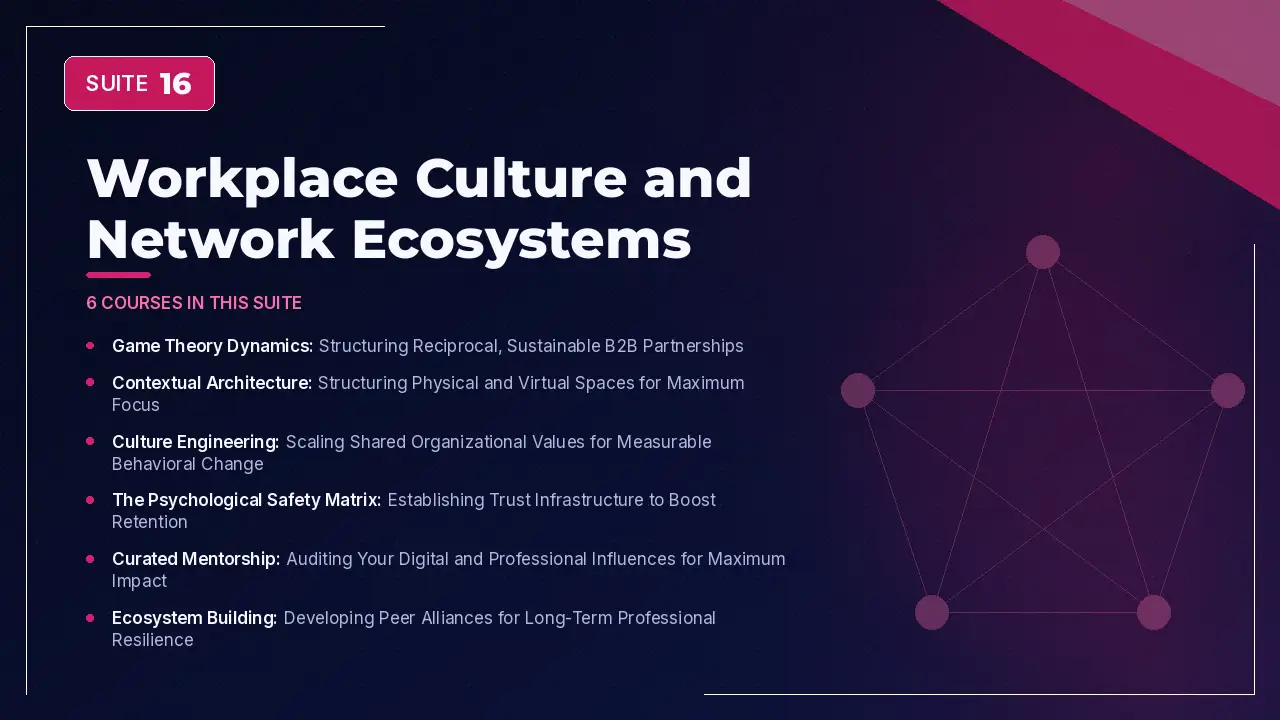
Scaling Shared Organizational Values for Measurable Behavioral Change

  • Game Theory Dynamics:
    Structuring Reciprocal, Sustainable B2B Partnerships
  • Contextual Architecture:
    Structuring Physical and Virtual Spaces for Maximum Focus
  • The Psychological Safety Matrix:
    Establishing Trust Infrastructure to Boost Retention
  • Curated Mentorship:
    Auditing Your Digital and Professional Influences for Maximum Impact
  • Ecosystem Building:
    Developing Peer Alliances for Long-Term Professional Resilience

What Will You Learn?

  • How to rewire cognitive patterns for high performance
  • How intuition and data work together in decision-making
  • How optimism improves operational outcomes in business

Course Content

Game Theory Dynamics
Structuring Reciprocal, Sustainable B2B Partnerships The most durable B2B partnerships are not the result of good contracts — they are the result of well-structured incentive alignment that makes mutual investment the rational choice for both parties over the long term. Game theory, the mathematical study of strategic decision-making between rational actors, provides a powerful set of frameworks for designing those incentive structures deliberately rather than leaving partnership dynamics to evolve through trial and error. You will learn to apply core game-theoretic concepts — prisoner's dilemma, repeated game dynamics, coordination problems, and the role of reputation in sustaining cooperation — to the practical design and management of B2B partnerships. The result is a more rigorous, systematic approach to relationship architecture that produces partnerships that are both more stable and more genuinely valuable for all participants over time.

Contextual Architecture
Structuring Physical and Virtual Spaces for Maximum Focus Environment is not background — it is a behavior driver. The physical and virtual spaces in which professionals work have a profound and largely underappreciated impact on the quality of attention, creativity, and collaborative output those environments produce. Contextual Architecture is a course in designing your professional environments — both physical and digital — as deliberate performance infrastructure rather than as incidental arrangements that happen to be where work occurs. You will audit your current work environments against a framework of focus-enabling, creativity-supporting, and collaboration-facilitating design principles — and make specific, practical adjustments to each environment that measurably improve the quality and quantity of valuable work it enables. As remote and hybrid work create broader latitude for individual environmental design, the professionals who treat that latitude as a strategic opportunity will have a significant and growing performance advantage over those who treat it as administrative trivia.

Culture Engineering
Scaling Shared Organizational Values for Measurable Behavioral Change Organizational culture is not what is written on the values wall — it is the aggregate of the behaviors that the organization systematically rewards, tolerates, and punishes. Every organization has a culture, whether or not it has been deliberately designed, and the gap between the stated culture and the operational culture is one of the most reliable predictors of organizational dysfunction, talent attrition, and leadership failure. Culture Engineering is about closing that gap through deliberate behavioral design. You will learn to conduct a rigorous organizational culture audit, identify the specific behavioral norms that are producing cultural outcomes — both positive and negative — and design targeted interventions that shift those norms in measurable, sustainable ways. Culture change is not a communication problem, a values-statement problem, or a training program problem. It is a behavioral design problem, and this course gives you the engineering methodology to solve it.

The Psychological Safety Matrix
Establishing Trust Infrastructure to Boost Retention Google's Project Aristotle — perhaps the most rigorous study of team effectiveness ever conducted — identified psychological safety as the single most important factor distinguishing high-performing teams from mediocre ones. When team members feel genuinely safe to take interpersonal risks — to speak up, to disagree, to admit error, to propose unconventional ideas — the quality of collective intelligence, learning velocity, and innovation output all increase dramatically. The Psychological Safety Matrix gives leaders a practical framework for building and maintaining that safety. You will assess the current psychological safety level on your team, identify the specific leadership behaviors and structural conditions that are suppressing it, and build a systematic protocol for creating the trust environment in which genuine intellectual honesty becomes the team's operating norm. High psychological safety is not a soft goal — it is a measurable driver of the retention, engagement, and performance outcomes that your organization most needs to improve.

Curated Mentorship
Auditing Your Digital and Professional Influences for Maximum Impact The people and content you consistently consume are reshaping your thinking, your ambitions, and your sense of what is possible — whether or not you are making those choices intentionally. Most professionals have never conducted a rigorous audit of their influence ecosystem: the mentors they are actively engaging, the communities they are participating in, the content they are consuming, and the peer groups that are setting their ambient norms for success and acceptable performance. Curated Mentorship is a course in taking conscious ownership of your influence environment. You will audit your current ecosystem with a clear framework, identify the relationships and inputs that are accelerating your growth and those that are inadvertently limiting it, and design a deliberately curated set of mentorship relationships, peer communities, and knowledge inputs that maximize the quality of influence you are receiving. Your environment is shaping you — this course helps you shape it first.

Ecosystem Building
Developing Peer Alliances for Long-Term Professional Resilience The most career-resilient professionals are not those with the longest résumé or the most impressive title — they are those with the deepest and most genuinely reciprocal professional networks: ecosystems of peer relationships built on real mutual investment that can provide intelligence, opportunity, support, and advocacy across the inevitable disruptions of a long career. Ecosystem Building is a course in constructing that resilience infrastructure deliberately rather than leaving it to the randomness of proximity and circumstance. You will learn to design a professional ecosystem with strategic intentionality: identifying the specific relationship categories your career most needs, building the genuine value exchange that makes those relationships reciprocal rather than transactional, and maintaining the network health practices that keep your ecosystem active, relevant, and genuinely useful over time. A strong professional ecosystem is not a networking accomplishment — it is a career survival strategy for a world where disruption is the only reliable constant.

Student Ratings & Reviews

No Review Yet
No Review Yet
Scroll to Top