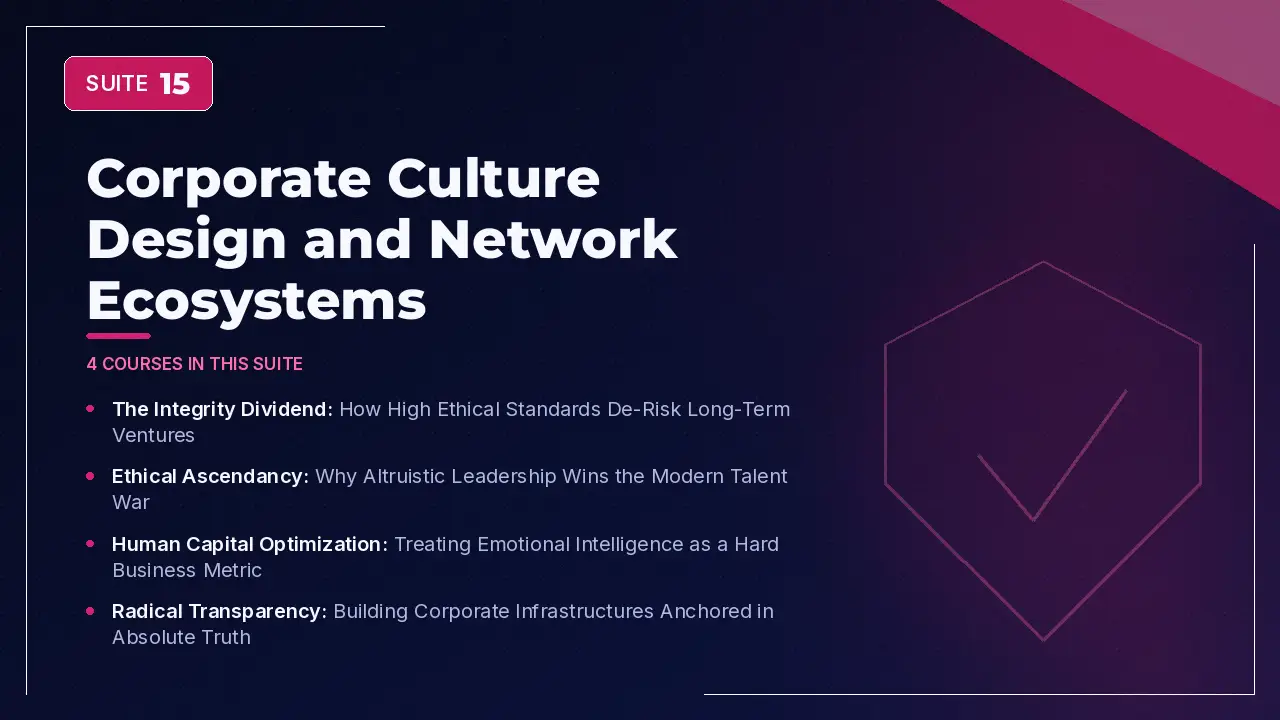
The Integrity Dividend:

By ldr.frontdesk Uncategorized
Wishlist Share

About Course

How High Ethical Standards De-Risk Long-Term Ventures

  • Ethical Ascendancy:
    Why Altruistic Leadership Wins the Modern Talent War
  • Human Capital Optimization:
    Treating Emotional Intelligence as a Hard Business Metric
  • Radical Transparency:
    Building Corporate Infrastructures Anchored in Absolute Truth
 

What Will You Learn?

  • Ethical leadership frameworks
  • Organizational trust systems
  • Culture-driven business growth

Course Content

The Integrity Dividend
How High Ethical Standards De-Risk Long-Term Ventures Integrity in business is frequently discussed as a moral imperative and almost as frequently dismissed as naive idealism by those who observe how often short-term expediency seems to be rewarded. The Integrity Dividend makes a different argument: that rigorous ethical standards are not primarily a moral choice but a strategic one, and that the long-term risk-adjusted returns to organizations and individuals who maintain genuine integrity consistently exceed those available to their less principled competitors. You will examine the specific mechanisms through which integrity creates durable competitive advantage — in talent retention, in customer loyalty, in partner and investor confidence, and in the organizational resilience that comes from a culture without the internal tensions of systematic dishonesty — and build the personal and organizational practices that make high ethical standards operationally real rather than aspirationally decorative.

Ethical Ascendancy
Why Altruistic Leadership Wins the Modern Talent War The competition for exceptional talent has shifted the leverage in the employer-employee relationship in ways that most organizations have been slow to fully internalize. The best professionals in every domain — the ones whose presence on a team measurably improves outcomes — now have choices, and they are making those choices increasingly on the basis of organizational values, leadership character, and the quality of the professional relationships on offer. Ethical Ascendancy examines what this means strategically for leaders who want to win that war. You will learn to build the leadership reputation and organizational culture that makes exceptional talent want to work with you — not because of the compensation package, but because of the quality of the environment, the authenticity of the values, and the character of the leadership. Altruistic leadership — genuinely prioritizing the development and wellbeing of the people you lead — is not soft strategy. It is the highest-return talent strategy available in the current market.

Human Capital Optimization
Treating Emotional Intelligence as a Hard Business Metric The organizational tendency to treat emotional intelligence as a soft skill — valuable but unmeasurable, nice to have but not essential — persists despite decades of research demonstrating that EQ is among the most powerful predictors of leadership effectiveness, team performance, and organizational resilience. Human Capital Optimization reframes emotional intelligence as what it actually is: a hard capability with measurable impact on the business metrics that organizations track most carefully. You will learn to assess emotional intelligence at both the individual and team level, design development interventions that build EQ capacity where it is most needed, and build the organizational practices that make emotional intelligence a genuine operating competency rather than a performance review category. The teams and organizations that take EQ as seriously as IQ — and build it as deliberately — consistently outperform those that continue to treat it as optional.

Radical Transparency
Building Corporate Infrastructures Anchored in Absolute Truth The organizational cost of information asymmetry — of leaders who curate the truth, of cultures that punish the messenger, of systems that reward the appearance of performance over its substance — is enormous and largely invisible until it becomes catastrophic. Radical Transparency makes the case for organizational honesty as a structural design principle rather than a personality preference, and examines the specific practices and infrastructure that make it operationally achievable. You will learn to build the communication systems, meeting architectures, and feedback mechanisms that give your organization genuine access to ground-truth information rather than the filtered, politically processed version that hierarchical organizations typically produce. Radical transparency is not about eliminating discretion or judgment — it is about ensuring that the people making the most consequential decisions have the most accurate information available to make them well.

Student Ratings & Reviews

No Review Yet
No Review Yet
Scroll to Top